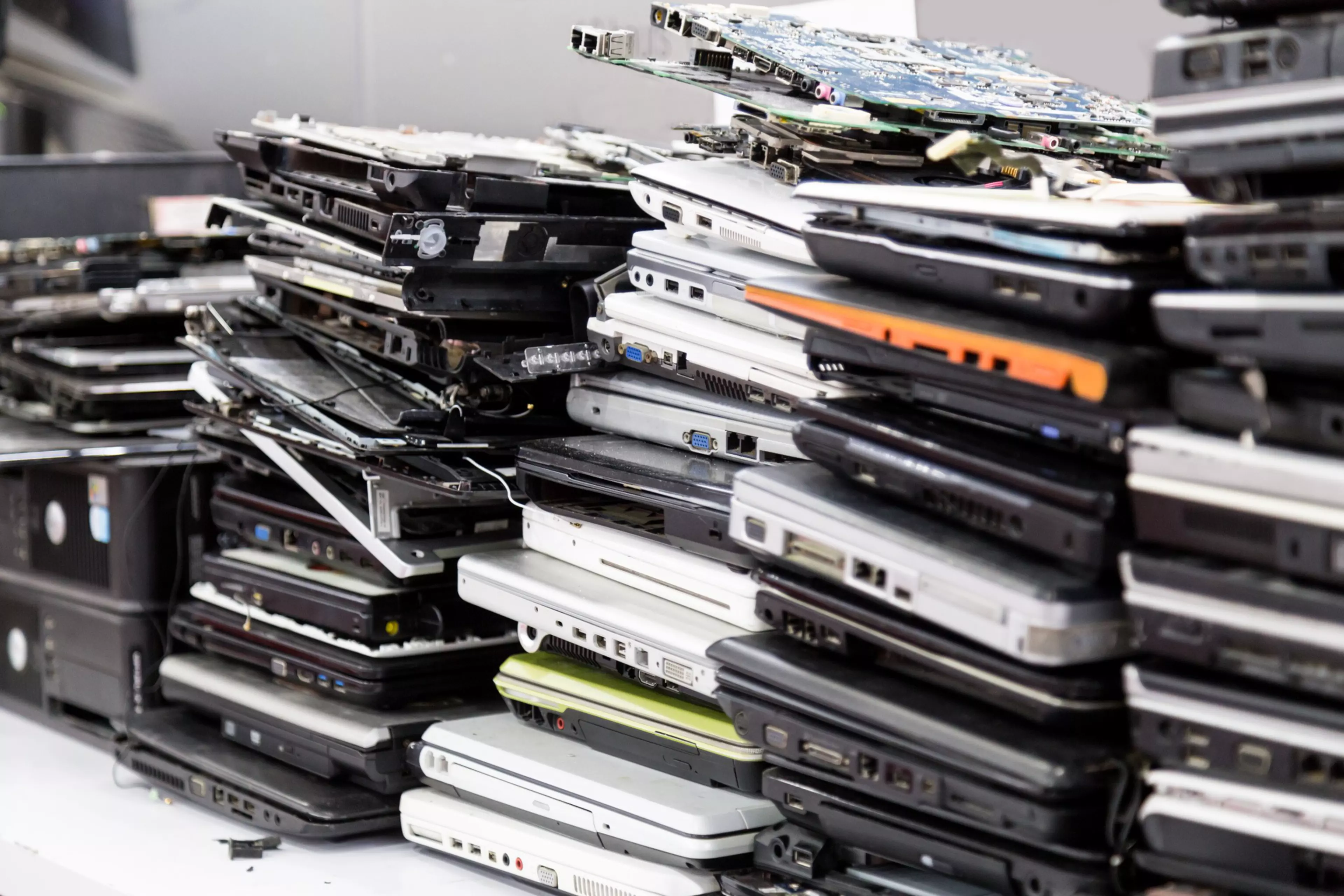
Climate change and climate mitigation

We're taking action on the climate change challenge
Konica Minolta is rising to the climate change challenge by working to reduce greenhouse gas emissions throughout the lifecycle of its products.
Our aim is to avoid and reduce energy consumption and greenhouse gas emissions as far as possible in the first instance. Secondly, we aim to substitute GHG-emitting power sources with renewable energy.
What are greenhouse gases (GHG)?
CO2 (carbon dioxide) emissions account for the largest share (76%) of greenhouse gases.
Other greenhouse gases are:
- Methane (CH4)
- Nitrous oxide (N2O)
- Hydrofluorocarbons (HFCs)
- Perfluorocarbons (PFCs)
- Sulphur hexafluoride (SF6)
We're reducing our energy consumption and greenhouse gas emissions
We've initiated a number of measures to reduce our greenhouse gas emissions.
Net Zero by 2050
Long term goal 2050: Konica Minolta commits to reduce absolute Scope 1, 2 and 3 GHG emissions by 90% by FY2050 from a FY2018 base year across the value chain in accordance with SBTi Corporate Net Zero Standard*. That means driving our global GHG emissions down throughout procurement, production, distribution, sales and service and product use. We were able to reduce our GHG emissions from FY2018 to FY2024 by 284 thousand tons CO2 which is 20.7%.
Near term goal 2030: Konica Minolta commits to reduce absolute Scope 1 and 2 GHG emissions by 51% by FY2030 from a FY2018 base year in accordance with SBTi Corporate Net Zero Standard*. We were able to reduce our GHG emissions from FY2018 to FY2024 by 77 thousand tons CO2 which is 23.2%. Konica Minolta also commits to reduce absolute Scope 3 GHG emissions from purchased goods and services, upstream transportation and distribution, use of sold products and end-of-life treatment of sold products by 30% within the same timeframe. We were able to reduce our GHG emissions from FY2018 to FY2024 by 121 thousand tons CO2 which is 16.6%.
*These emissions do not represent the total emissions from the supply chain.
Raw materials and the manufacturing processes
All Konica Minolta factories are working under a certified ISO 14001 Environmental Management System. Additionally, Konica Minolta has developed an own factory certification system, which is applied to own and main supplier’s factories, managing among others, CO2 emissions. From FY2018 to FY2024, we’ve reduced CO2 emissions by 23.4% (or 64 kt CO2).
AIRe Link for remote diagnostics

- More than 18,000 on-site customer visits across Europe
- Around 3.2 million kilometres on the road
- 512 tons of travel-related greenhouse gas emissions
Towards 100% renewable energy usage

- Our European headquarters and many subsidiaries already use 100% or nearly 100% green electricity (Austria, Belgium, France, Germany, Great Britain, Italy, Lithuania, the Netherlands, Portugal, Spain and Sweden).
- Three factories in Japan, China and Malaysia and our two toner factories in France and the U.S. use 100% renewable energy, which means all Production Printing devices and about 47% of all office devices of our current fleet sold in FY 2024 for the European market (on a value basis) have been produced in factories using 100% renewable energies.
The environmental impact of our printing devices
For 72% of the office devices and for all production printing devices from our European product portfolio we can provide a third party approved Lifecycle Assessment including a Product Carbon Footprint, through SuMPO EPD.
Our bizWORKPLACE total cost of ownership (TCO) assessment tool provides an environmental audit of the printer fleet. It determines the energy consumption of printers and the consumption of consumables, such as paper and ink/toner. Furthermore, it provides periodic environmental reporting to ensure optimised performance over time.
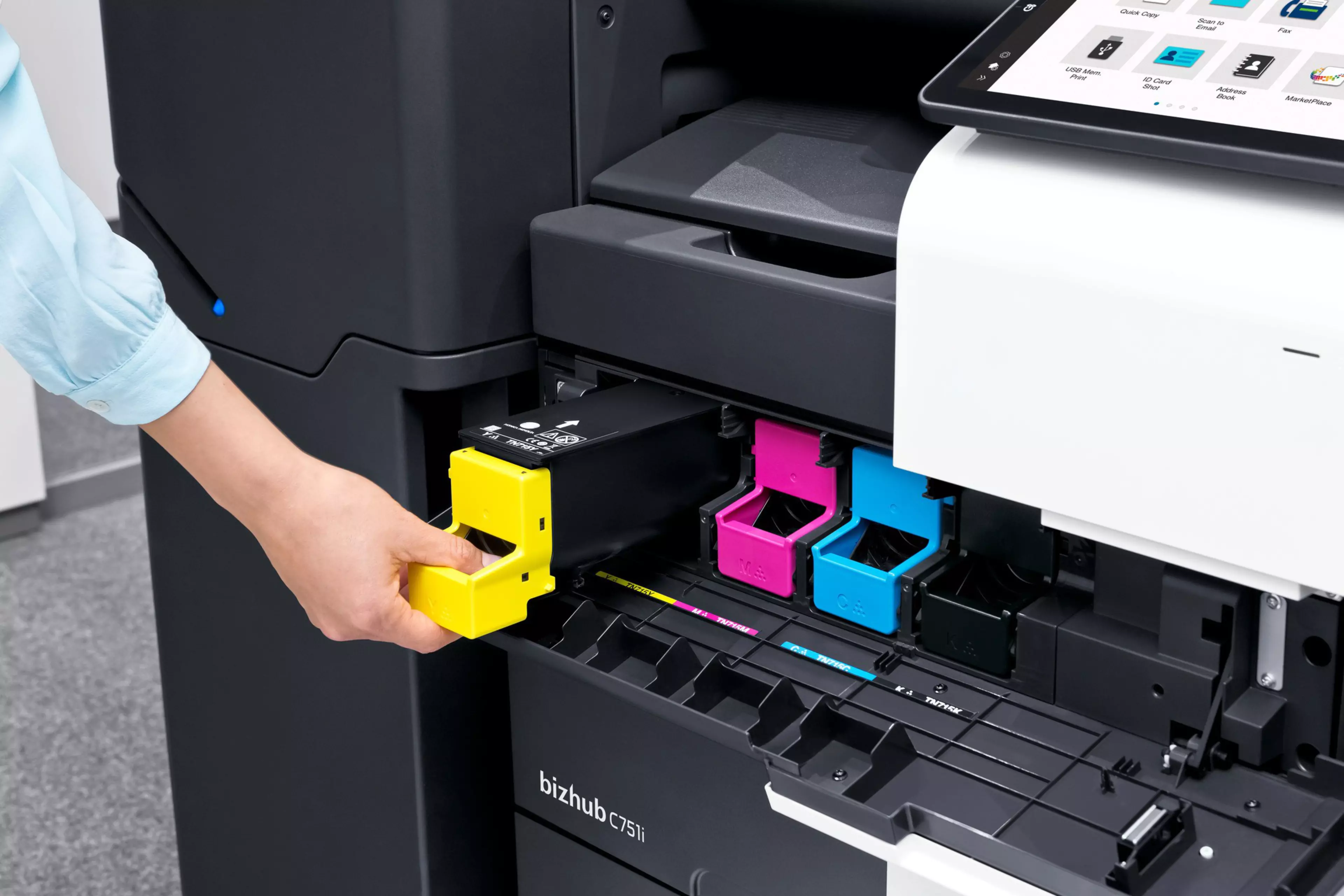
During printing, the largest energy consumption – over 60% – occurs when the toner is fixed to the paper. With our polymerised Simitri® V toner used in the bizhub i-series (our latest MFP generation) we've reduced the fixing temperature by about 15°C compared to previous models. Combined with a new fixing device, this helps to significantly reduce the MFPs' weekly TEC (typical energy consumption) value. The reduction in power consumption has resulted in our customers producing up to 22% (varies by model) less CO₂ emissions in operation compared to previous models.
Use the energy saving potential of our bizhub devices
Further, we want to give you some useful tips on how you can save power and resources by modifying the way you print and use the Konica Minolta office devices.
To use the energy potential of our devices, we recommend special power save settings, which are highly effective while guaranteeing remote management capability for the devices.
And we also have additional tips to share on how to further optimise printing and reduce print-related waste.
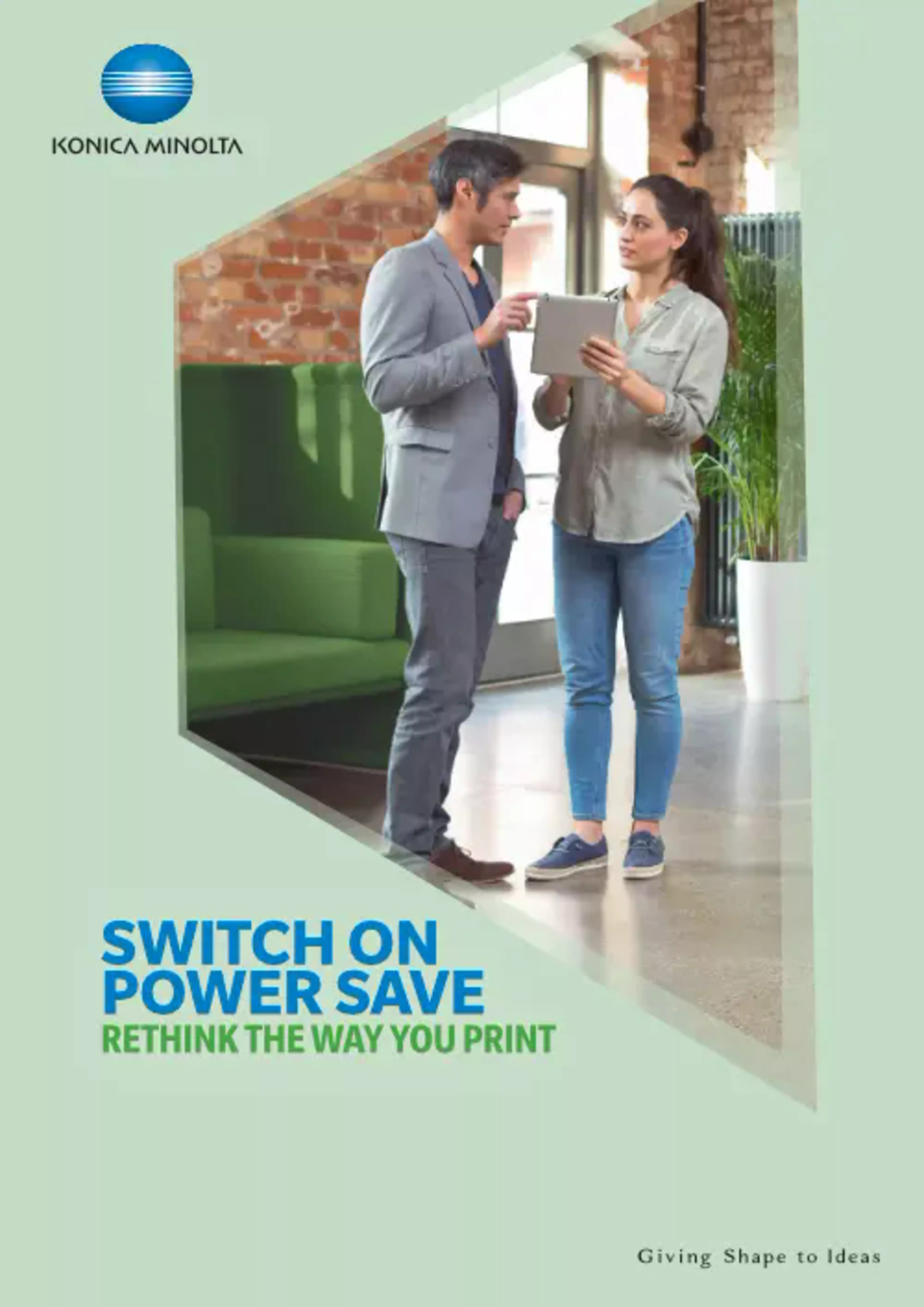
Power Save settings
Power Save settings help you optimise management of your bizhub MFPs' energy consumption. Depending on your device, you'll have access to some or all of the following settings to help you reduce energy usage:
- Low power mode – automatically turn the display off after two minutes instead of 15
- Sleep mode – set sleep mode to kick in after two minutes instead of 20.
- Timer and calendar function – the low power and sleep modes have a timer and calendar function that allows the system to be activated on a daily or weekly basis, or according to the calendar date.
- Dynamic Eco Timer – manages the sleep and operating mode times for each day of the week. Enhanced by a learning function, it automatically adapts to your actual usage based on a four-week analysis.
- Eco Print – when the system is in sleep mode, the control panel doesn't automatically activate if a print job comes in. To minimise unnecessary power consumption, power is provided to the required device components only.
- Eco Scan – Scan-only technology means that the toner-fixing heater won’t be activated if the device is being used for scanning only. In addition, our newer devices feature an integrated dual scanner as standard, which reduces the scan time and energy consumption.
- Eco Meter / Eco Info – displays information such as toner and paper savings and summarises the times in operation and sleep modes for the device, an account, or a user. Visualising the contribution to the environment in this way helps to create and maintain environmental awareness.
Find out more about our Environmental approach


Why we do not offer CO₂ offsetting?
At Konica Minolta, our approach to climate action prioritizes the avoidance and reduction of greenhouse gas emissions within our own value chain.
Recent EU regulatory developments, in particular the Directive as regards empowering consumers for the green transition (EmpCo Directive), aim to prevent misleading environmental and climate-related claims. According to these developments, claims of a neutral, reduced, or positive climate impact must not be based on the compensation of emissions outside a company’s own value chain, but must instead be based on the actual lifecycle impact and real emission reductions within the value chain, in order to avoid misleading consumers.
Against this background, Konica Minolta Europe has decided not to offset CO₂ emissions. Instead, we focus consistently on real and measurable emission reductions and on supporting our customers in reducing their own carbon footprint.
Download


Find out more about our ESG services:
Further reading
Diversity, Equity and Inclusion: Why companies benefit from it

Digital Accessibility: A Key to Inclusion and Equal Opportunity in the Workplace

When boundaries disappear - how healthy is hybrid working for mental health?

Where is the best place to work: in the office or at home and how to reach a compromise between employee and employer wishes?

The EU CSDDD: Responsibility along the supply chain

CSRD reporting for SMEs – in just a few steps with AI

Three digitalisation initiatives that have a positive impact on an organisation’s sustainability

Five ways to clean up your data ‘junk' and save energy

Just how sustainable are data centres and Cloud Services?

Six ways to reduce the environmental impact of your print infrastructure

How can you help to reduce or avoid plastic waste?

Can digital transformation be sustainable?