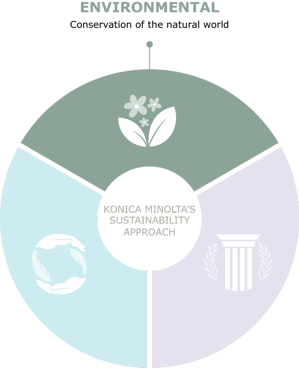
Environmental
Conservation of a natural world

Tackling global environmental challenges together
The rapid changes taking place in society and in the built and natural environments are having a profound effect on the environment. All of us — governments, NGOs, corporations and individuals — have a shared responsibility to protect and preserve the environmental balance.
Key environmental challenges
Key challenges relating to the global environment include:
- Climate change: Global temperatures in 2022 were 0.89°C above the average baseline figures 1951–1980. Warming above 1.5°C risks further sea level rises, extreme weather, biodiversity loss and species extinction, as well as food scarcity and worsening health and poverty for millions of people worldwide.
- Fossil fuels: Coal, oil and gas burned for energy are non-renewable and currently provide around 80% of the world's energy. Emissions from fossil fuels are the main cause of global warming. In 2018, 89% of global CO2 emissions came from fossil fuels and industry.
- Deforestation: Every year 10 million hectares of forests are lost through deforestation. As well as reducing the environment’s ability to absorb excess CO2 created by human activities, deforestation actually adds to CO2 levels. The deforestation problem is worsened by the hotter, drier weather caused by climate change that helps to create conditions that extend forest fire seasons.
- Pollution: Global pollution, such as plastics in the oceans (8 million tonnes are dumped every year) and the ingress of microplastics into the ecosystem, is supplemented by regional issues such as the pollution of land and fresh water supplies from human activities.
All these problems have led to the threat of extinction of around a million animal and plant species — many within decades, and more than ever before in human history.
Environmental initiatives at Konica Minolta
As part of our broader ESG commitments, Konica Minolta is committed to contributing positively to its own environmental impact and that of its customers and partners. Our activities on climate change, the circular economy, and cutting pollution are integral to our commitment and include the following.
Climate change and climate mitigation
A commitment to net zero. For example, we've committed to becoming net zero by 2050, reducing our global GHG emissions by 90% by FY2050 compared to FY2018 across the value chain in accordance with SBTi Corporate Net Zero Standard*. That means driving our global GHG emissions down throughout procurement, production, distribution, sales and service and product use. We were able to reduce our GHG emissions from FY2018 to FY2024 by 284 thousand tons CO2 which is 20.7%.
- Switching to renewable energy to reduce CO2 and the production of other harmful greenhouse gases. As a member of RE100, we're committed to obtaining 100% of the electricity we use from renewable energy sources by 2050. Konica Minolta's European headquarters and many subsidiaries already use 100% (or nearly 100%) green electricity, as do five of our factories.
*These emissions do not represent the total emissions from the supply chain.
Resources and the circular economy
- In 2050, we aim to make our products from more than 90% circulated resources (recycled materials and biomaterials). We will achieve this by:
- Increased reuse of plastics: For instance, our toner bottles are up to 60% of recycled materials1 and our current office devices consist of up to 38.6% of recycled plastic2 (or up to 40.4% according to German Blue Angel mark) and our production printing devices up to 31.9% of recycled plastic3.
- Refurbishment, resale and reuse of products: In Europe, we've established a program for refurbishment of MFPs according to strict standards; our toner bottles can be refurbished and refilled.
- Better recycling and resources usage: In FY2024, 14,300 tonnes of end-of-life office equipment were taken back, 99.3% of which were recycled. 24 European Countries offer a program to collect and recycle used consumables.
1 As of September 2024
2 according to calculation based on EPEAT as of 11/2025
3 according to calculation based on EPEAT as of 11/2025
Pollution
- Cutting pollution by reducing transportation and making it more efficient. Where possible, we're trying to shift transport across Europe from air and road to rail or water.
- 90% of our goods transported from Rotterdam, Netherlands, to our main warehouse in Emmerich, Germany, are carried on barges on the Rhine.
- 40% of transport from Emmerich to Italy is by rail.
Konica Minolta’s products are certified with proven labels & standards

Blue Angel
The Blue Angel mark was established in 1978. It is now one of the best-known ecological labels. Konica Minolta systems were the first laser-based copier systems worldwide to be awarded in 1992. Nearly all of the current office devices sold in Germany carry this label. All devices comply with the requirements of the strict German label even those sold outside Germany.

De-inking
The removal of ink or toner from paper is crucial for the production of recycled paper. This is guaranteed with Konica Minolta’s toners (e.g.Simitri® HD & Simitri® V), which achieved top results in the INGEDE deinking test.

SuMPO EPD
SuMPO EPD (SuMPO Environmental Product Declaration (formerly EcoLeaf)) is a Japanese program that provides third-party verified information on the environmental impact of a product, based on quantitative measurement of the environmental performance through the product’s entire lifecycle, from raw materials procurement to production, sales, usage, disposal and recycling. The underlying program is based on the following international standards: ISO 14025:2006, ISO/TS 14067: 2013, ISO 14040: 2006, ISO 14044: 2006 and ISO/TS 14027:2017. Konica Minolta provides environmental impact data including a product carbon footprint, for the majority of its product through the SuMPO EPD.

Food Contact
The product properties of our Simitri® toner mean that TÜV Rheinland recognises it as 100% harmless for indirect food contact. This food safety certification allows it to be used for applications such as food packaging or food label printing.
EN 71 (Toy Safety)
This norm ensures that toys, especially those made for children, are safe, usually through the application of set safety standards. The European standard EN 71 is a broad framework of very different requirements. Konica Minolta printouts were tested according EN 71-3 (Specification for migration of certain elements) and EN 71-9 (Organic chemical compounds – Requirement) successfully. That means that a toy can contain printed parts, like a puzzle piece and the printout will be safe. In 2021, we started with AccurioJet KM-1e, AccurioPress C14000 and AccurioPress C7100. The first devices can be used for this purpose and the list of tested devices will be enhanced over the years.

Seawater resistance
There is a British standard for label and for colorants, which ensures your imprint will survive a certain time being expose to seawater. By using the corresponding label and our awarded devices you will still be able to read the content of your printed message.

Fogra
The Fogra VPS (Validation Printing System) certification is aimed at digital printing system providers and serves as proof of the conformity of their product with the criteria of ISO 12647-8. The print production devices are checked for various printing conditions covering a wide range of capabilities. These included PDF/X conformance, proofing substrate colour, gloss and fluorescence, colour accuracy, uniformity, permanence, and light fastness. Other factors were fading, long and short-term repeatability, print rub resistance, colorimetric tone value transfer, tone value reproduction limits, image register and resolving power and margin information. Print Providers benefit from a proven and certified production devices with the guarantee of highest print quality and reliability.
Document authenticity by PTS
There is an Ordinance for Lawyers and Notaries in Germany (DONot), § 29 that gives the framework for making manipulation to printouts impossible. Documents should be very fine and detailed; also, every attempt to change the content of prints must be visible. The majority of our devices is able to fulfil these criteria.
An iterative process
We've been working to reduce our environmental impact for many years, but are well aware it's an iterative process that doesn't end. We know there are areas where we have the potential to improve, and we're committed to doing so: we view our current activities as a starting point on which to build.
Learn more about how Konica Minolta is addressing its environmental obligations:




Download


Find out more about our ESG services:
Further reading
Diversity, Equity and Inclusion: Why companies benefit from it

Digital Accessibility: A Key to Inclusion and Equal Opportunity in the Workplace

When boundaries disappear - how healthy is hybrid working for mental health?

Where is the best place to work: in the office or at home and how to reach a compromise between employee and employer wishes?

The EU CSDDD: Responsibility along the supply chain

CSRD reporting for SMEs – in just a few steps with AI

Three digitalisation initiatives that have a positive impact on an organisation’s sustainability
Five ways to clean up your data ‘junk' and save energy

Just how sustainable are data centres and Cloud Services?

Six ways to reduce the environmental impact of your print infrastructure

How can you help to reduce or avoid plastic waste?

Can digital transformation be sustainable?