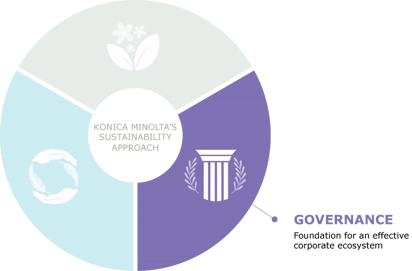
Governance
Foundation for an effective corporate ecosystem

Being a good corporate citizen
Effective corporate governance creates an environment of trust, transparency, fairness and accountability, which together help to foster long-term investment, financial stability, and business integrity. These attributes support stronger growth and more inclusive societies, as well as the responsible use of resources, and protection of the built and natural environments. An essential element of ESG, governance is the backbone of these efforts for any business that strives to be a ‘good corporate citizen.’
Key governance challenges
Corporate governance is required to support the business itself and to help it meet its wider obligations to the local, national and global community. Key governance challenges include:
- Pressure and expectation on businesses to be sustainable and responsible: The Edelman 2022 Trust Barometer shows that 65% of consumers believe that companies are better at solving social challenges compared to governments (42%) or NGOs (57%). However, the survey suggests that consumers believe businesses aren’t currently doing enough to address societal problems on climate change (52%), economic inequality (49%) and workforce reskilling (46%).
- Compliance: Companies must comply with a raft of laws and regulations. EU examples include CSRD, GDPR, and the upcoming EU Corporate Sustainability Due Diligence Directive (CSDDD).
- Complex ethics laws and regulations: A particular challenge when a business trades across multiple countries or regions, making ethical, trustworthy business practices and robust processes of governance increasingly essential. Business leaders need to understand the obligations of their governance and implement strict processes to avoid financial penalties and potential reputational damage.
- Supply chain: When choosing partners and the supply chain, factors like ethics and sustainability are as important as optimal service, support and pricing. A partner or supplier that fails to meet sustainability or ethics expectations will reflect badly on any business that supports it, so thorough due diligence must be carried out.
- A balanced corporate strategy: Although a corporate strategy that focuses exclusively on maximising shareholder benefits (and ignores broader obligations) no longer meets the challenges and expectations a company faces, this must be weighed against the pressure to ensure the business remains profitable and financially viable to survive and thrive in its chosen markets.
Governance initiatives at Konica Minolta
Effective corporate governance is essential to ensuring a business meets its obligations to internal stakeholders (employees) and external stakeholders (investors, customers, and anyone else affected by the business’s activities).
As a major international corporation that operates in multiple regions and territories, Konica Minolta has a strict set of policies that ensure the company, its employees, and its partners all meet stringent governance standards.
Our approach to governance includes:
Sustainable & responsible business conduct
- Compliance with applicable laws and regulations in the countries and regions where we operate (eg CSRD, the Act on Corporate Due Diligence Obligations in Supply Chains).
- Data protection best practice and GDPR compliance through a policy that exceeds GDPR requirements and gives customers the highest level of protection, wherever they're located.
- Prevention of fraud, corruption and money laundering through our Anti-Fraud/Corruption Policy, European Anti-Money-Laundering Policy and other related policies.
Governance, risk management and internal controls
- Konica Minolta is aware of potential risks and have suitable mitigation in place to ensure these are dealt with. It is vital that this is controlled throughout the organisation and that the whole team understands what is acceptable and what is not.
Products & Services – Management and quality with business partners
- Konica Minolta is working towards a sustainable and ethical supply chain by ensuring that the company and its suppliers respect human rights, based on, among others: the Responsible Business Alliance (RBA), our Supplier Code of Conduct, and the upcoming EU Corporate Sustainability Due Diligence and amending Directive (CSDDD).
- Effective export control procedures to ensure we comply with prevailing sanctions and embargoes.
Our compliance with European regulations
Konica Minolta is compliant with European regulations and laws applying to our business as well as acknowledges voluntary agreements.
Circular Economy Package: Set of measures to stimulate Europe's transition towards a circular economy, boost global competitiveness, foster sustainable economic growth and generate new jobs. We take measures to support the achievement of the European circular economy goal.
The Waste Framework Directive (WFD) is a European Union Directive concerned with "measures to protect the environment and human health by preventing or reducing the adverse impacts of the generation and management of waste and by reducing overall impacts of resource use and improving the efficiency of such use". The aim of the WFD was to lay the basis for turning the EU into "a 'recycling society' seeking to avoid waste generation and to use waste as a resource". Konica Minolta is compliant with the WFD.
Eco Design Directive: EU Directive that provides consistent EU-wide rules for improving the environmental performance of products. Konica Minolta is compliant with the relevant Eco Design Directives.
Registration, Evaluation, Authorization and Restriction of Chemicals (REACH): EU regulatory framework that requires the registration and management of all chemical substances used in businesses in accordance with their conditions of use to ensure safe assessment of chemical substances. Konica Minolta is compliant.
Restriction of certain Hazardous Substances (RoHS): EU Directive that restricts (with exceptions) the use of ten hazardous materials in the manufacture of various types of electronic and electrical equipment. Konica Minolta is compliant with the RoHS Directive.
Battery Directive: EU Directive that regulates the manufacture and disposal of batteries in the EU with the aim of improving the environmental performance of batteries and accumulators. Konica Minolta is compliant.
Substances of concern in Products (SCIP): Starting 5 January 2021 all companies in the EU are required to report information into the ECHA SCIP database for any product they supply in the EU which includes articles that contain REACH Candidate List substances above 0.1 % by weight of the article. The database shall enable recycling companies to remove hazardous substances from the closed loop. Konica Minolta is compliant with SCIP.
Waste Electrical and Electronic Equipment (WEEE): EU Directive; in Europe, the company has adopted measures in conformity with the EU Directive WEEE on the disposal of waste electrical and electronic equipment and is compliant with this directive.
An iterative process
We aim to be highly responsible across our sourcing and supply chains, with due diligence at the forefront of our operations. We do, however, acknowledge that our actions in the governance field represent important early steps in an ongoing the journey. We're aware that there are still areas where we have the potential to improve, and we aim to do so. The actions described above represent a firm foundation on which we intend to continue building.
Learn more about how Konica Minolta is addressing its governance obligations:




Download


Find out more about our ESG services:


Further reading
Diversity, Equity and Inclusion: Why companies benefit from it

Digital Accessibility: A Key to Inclusion and Equal Opportunity in the Workplace

When boundaries disappear - how healthy is hybrid working for mental health?

Where is the best place to work: in the office or at home and how to reach a compromise between employee and employer wishes?

The EU CSDDD: Responsibility along the supply chain

CSRD reporting for SMEs – in just a few steps with AI

Three digitalisation initiatives that have a positive impact on an organisation’s sustainability

Five ways to clean up your data ‘junk' and save energy

Just how sustainable are data centres and Cloud Services?

Six ways to reduce the environmental impact of your print infrastructure

How can you help to reduce or avoid plastic waste?

Can digital transformation be sustainable?